
Using Email to Share Stories and Build Connection (Not Just Dump Recipe Links)
If you’re a food content creator, email marketing is one of the most valuable platforms you have for building a connection with your audience.
And yet, many people have let it go stale in the same way as their blog or social media.
Most email newsletters I see from food bloggers follow a standard template and dump more links, more content, more noise. Sometimes, without much structure or reason at all.
But what if your email marketing was more than just a way to drive traffic? What if it became a place where your readers got to know you?
Not just what you cook… but why you cook. Not just what to make… but what it means.
In this post, I’m breaking down my experience with storytelling-driven email marketing strategy for a food blog — and why it’s led to stronger engagement, higher open rates, and deeper reader connection.
The Power of Story-Driven Emails for Food Content Creators
Over the past several months, I’ve been helping Plays Well With Butter make this subtle shift in their email marketing strategy.
Instead of leading with links, we’ve been leading with stories in the format of longer-form, more personal, emotionally driven emails. (The kind of writing you might associate with old school blogging days!).
The emails we’re writing feel less like a content roundup and more like a letter: reflective, narrative, and rooted in real life.
When Our Emails Shifted, Readers Responded
As part of this narrative email shift, we started sending more emails. Because connection grows with consistency, and it turned out we had a lot to share.
Yet despite an increase in email frequency, open rates have consistently stayed in the 40–50% range.
A lot of food content creators tell me they’re afraid to email more because they don’t want to “turn people off” or “bother them.” But if you’re emailing the right messages, this really doesn’t need to be a concern.
The numbers show that Plays Well With Butter subscribers continue to engage with these new emails, just as much (if not more) as with the recipe roundups we’ve traditionally sent.
But even more importantly, our storytelling emails are actually getting responses from readers.
People have actually been replying to say thank you, share their own stories, or reference past emails.
Our emails are helping readers feel something — nostalgia, comfort, curiosity, recognition — which makes them far more likely to stay engaged over time. (And this engagement is good for the health of our list!)
They genuinely enjoy hearing from Jess.
Storytelling Around the Lunar New Year
Here’s an example of an email we sent in February:
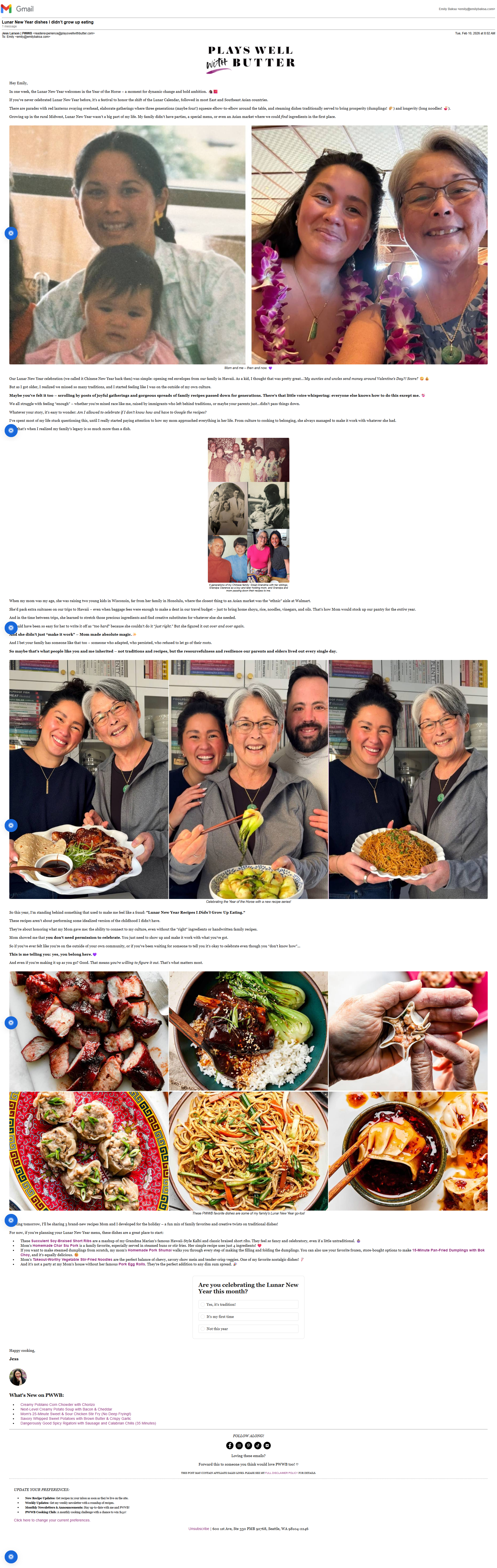
At its core, this email is about Lunar New Year recipes. But that’s not really the focus of the email.
It opens with personal history, vulnerability, and struggle around growing up as an Asian-American in the rural Midwest.
It shares family photos to bring the characters to life.
It invites the reader into a lived experience.
Then, when the recipes come later, they feel grounded in something deeper. They’re not just links. They’re part of a story.
That’s what makes the difference.
Instead of saying, “Here are some recipes you might like,” the email shows: “This is where these recipes come from. This is why they matter. This is how they’ve lived in my life.”
That context transforms how the reader experiences everything that follows.
Why Storytelling Works So Well in Email Marketing for Food Bloggers
Stories create emotional entry points that help build familiarity and trust. As a food content creator, your connection with readers is your most powerful differentiator in a world of AI.
This format helps Jess’ emails feel interesting and distinct in a crowded inbox. People feel like they know her more, which means they are most likely to engage with her content.
This doesn’t mean every email needs to be 4x as long or deeply emotional.
What I’ve learned through experience writing these emails is that there’s value in creating space for connection.
You can start to make this shift by:
Opening with a personal story before sharing links (as long as it’s relevant!)
Talking about the why behind a recipe, not just what a dish is
Sharing moments from your kitchen or life
Letting your personality and voice shine through, rather than trying to sound like everyone else
Eventually, your emails start to feel less like newsletters and more like conversations.
That’s how your email marketing becomes both a traffic tool and a relationship-building tool — something every food blogger needs as search and social continue to evolve.